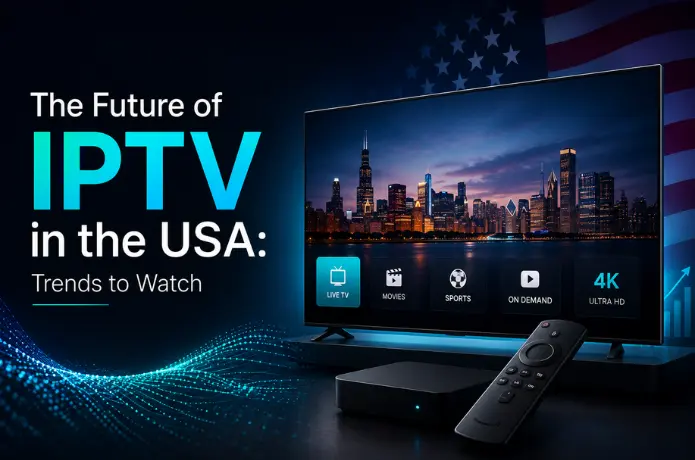

The Future of IPTV in the USA: Trends to Watch
Ten years ago, cutting the cord meant giving something up. You could save money, sure, but you'd lose live sports, miss local news, and spend half your time explaining to relatives why you no longer had "real" TV. The trade-off was real and most people weren't willing to make it.
That conversation has completely changed. Today, IPTV subscribers in the USA aren't sacrificing anything — they're watching more content, on more devices, for significantly less money than what cable ever offered. And the technology driving all of it is still moving fast.
So where does IPTV go from here? What's actually changing in the next few years, and what should you be paying attention to as a viewer? Here's an honest look at the trends shaping the future of IPTV in the USA.
Cable's Decline Is Not Slowing Down
The numbers tell a clear story. Traditional cable TV has been losing subscribers every single quarter for years, and that pace is not letting up. What started as a slow drift has become something closer to a flood — millions of American households every year deciding they simply don't need a cable box anymore.
What's driving it isn't just price, though cable costs are genuinely hard to justify. It's the combination of long-term contracts, equipment rental fees, channels nobody watches, and support experiences that have historically been among the worst in any industry. When IPTV started offering more channels, better flexibility, and a fraction of the monthly cost, it wasn't a close comparison.
By the time we get to the end of this decade, traditional cable TV in the USA will look a lot like landline telephone service does today — still used by some, but no longer the default for most households. IPTV, in various forms, will have taken that place.
Internet Infrastructure Is Getting Faster — And That Changes Everything
One of the quiet stories behind IPTV's rise is what's been happening to US broadband. Fibre internet has been expanding steadily across the country. 5G home internet is now available in many markets as a serious alternative to traditional ISPs. And speeds that would have seemed extraordinary five years ago are now standard residential plans.
This matters enormously for IPTV. Better internet infrastructure means smoother streams, lower latency during live events, and the ability to support higher quality video without buffering. It also makes multi-device households — where three or four people might be streaming different things simultaneously — far more practical than they were even a few years ago.
As fibre coverage expands further into suburban and rural areas, the audience for high-quality IPTV will grow with it. People who previously couldn't get a reliable enough connection to stream live TV will find themselves in a position to cut the cord for the first time.
4K Is Becoming the Standard — Not the Premium
Not long ago, 4K streaming was something you paid extra for. A special tier, an add-on, a feature reserved for the highest-cost subscription.
That's already shifting. 4K Smart TVs are now the default purchase at most price points, and consumer expectations are moving with them. People buying a new television in 2026 expect to watch content that actually uses the screen they bought.
For IPTV providers, this means 4K channel availability is increasingly becoming a baseline expectation rather than a differentiator. Services that only offer HD while everything around them moves to 4K will find it harder to retain subscribers. The pressure to upgrade infrastructure and expand 4K content is real, and it's not going away.
Looking further ahead, 8K is beginning to appear in high-end consumer hardware. It's not a mainstream concern yet, but it gives you a sense of the direction the industry is moving. The resolution floor keeps rising, and IPTV services that want to stay relevant need to move with it.
Personalisation Is Getting Smarter
If you've used a streaming service in the last couple of years, you've already experienced early versions of AI-driven content recommendation. The homepage that suggests shows based on what you've watched, the "because you watched X" row, the algorithm that quietly learns your habits over time.
That's just the beginning of what's coming. The next generation of IPTV interfaces will use viewing data to do far more than suggest a show. Imagine an EPG that reorders itself based on what you actually watch, automatically filters out content types you've never engaged with, and surfaces live events in the sports or genres you follow before you even think to look for them.
For families, this gets more interesting. Personalisation at the profile level — different recommendations, different content filters, different favourites lists — will make shared subscriptions feel as tailored as individual ones. You won't need to scroll past two hundred channels you've never opened to find the news channel you watch every morning.
Live Sports Will Remain the Most Contested Ground
If there's one area where the streaming wars get genuinely complicated, it's live sports rights. Sports are the last remaining reason many households stick with cable, and both traditional broadcasters and streaming platforms know it.
In the USA, the landscape is shifting. Streaming deals for NFL, NBA, and MLB games have expanded significantly. Amazon, Apple, and Google have all moved into sports broadcasting in meaningful ways. The exclusive streaming deal is becoming more common, not less.
For IPTV viewers, this creates both opportunity and complexity. On one hand, more sports content is available through internet-based services than ever before. On the other, rights fragmentation means that following every league you care about through a single service is becoming harder, not easier. The household that wants NFL, NBA, international football, and Formula 1 all in one place is increasingly rare to find through any single provider.
Services like FireLive TV — which covers both US leagues and international sports in a single subscription — are well positioned in this environment. For the viewer who follows sport across multiple countries and leagues, breadth of coverage matters more than exclusive rights to a single league.
Multi-Device Viewing Is Now an Expectation, Not a Bonus
A few years ago, the ability to watch your subscription on more than one screen felt like a premium feature worth paying extra for. Families would negotiate over who got to use the main account, and hitting a "too many streams" error mid-match was a genuine frustration.
That expectation has completely flipped. Households now assume that one subscription covers everyone — the TV in the living room, the phone in a teenager's bedroom, the laptop someone's watching at the kitchen table. Services that still charge per device or restrict to a single stream are going to find it increasingly difficult to compete.
This is one of the areas where IPTV has a natural advantage over traditional cable. A single FireLive TV subscription already works across Smart TVs, phones, tablets, laptops, Fire Sticks, Apple TV, and Android boxes — all under one plan, with no per-device fees. That kind of flexibility is what modern households actually need, and it's becoming the baseline expectation across the industry.
Security and Reliability Will Separate Serious Providers From the Rest
There is a pattern in the IPTV market that has been consistent for years. A new provider launches with an attractive price and a big channel count. Subscribers sign up. A few months later the service goes down — either from technical failure, legal action, or simply the operator moving on — and those subscribers are left with no access and no refund.
This is not a small problem. It happens regularly enough that it's become one of the standard warnings in any IPTV buying guide. And it's one of the clearest ways to distinguish between IPTV providers that are building something sustainable and those that aren't.
As the market matures, the providers that survive will be the ones investing in proper infrastructure, maintaining transparency with their subscribers, and offering real support when something goes wrong. The cheap-and-unstable end of the market will keep churning through operators, while the reliable services build real subscriber bases.
For viewers, the practical lesson is the same one it's always been — test before you commit, look for real support, and pay attention to whether a provider is transparent about what they offer. A free 24-hour trial with no credit card required is a reasonable signal that a provider is confident in their service. A requirement to pay upfront with no trial is not.
Regulation Is Coming — and That's Probably Good
The IPTV industry in the USA has operated in a relatively unregulated space compared to traditional broadcasting. That's starting to change. Regulatory attention on unlicensed content distribution has increased, and enforcement actions against providers operating without proper licensing have become more frequent.
From the perspective of a legitimate IPTV subscriber, this is mostly positive news. Stronger enforcement means fewer fly-by-night providers flooding the market with cheap, unreliable services that disappear after a few months. It raises the floor for what counts as a credible IPTV service and makes it easier to distinguish providers who are operating properly from those who aren't.
The long-term effect is a healthier market — fewer operators, but more reliable ones. And for subscribers who have already chosen a transparent, well-run service, there's very little to worry about.
What This Means for You Right Now
The trends above paint a fairly clear picture. IPTV is not a niche alternative to cable anymore — it is becoming the default way most American households will watch live television. The technology is improving, the content is expanding, and the pricing gap between IPTV and traditional cable continues to widen.
If you're still on cable, the question is less "should I switch" and more "when." The longer you wait, the more you're paying for an infrastructure that is actively shrinking while the alternative keeps getting better.
If you're already on IPTV, the things worth paying attention to are the quality and reliability of your provider, whether they're keeping up with 4K content, and whether their channel lineup covers everything your household actually watches.
If you haven't tried FireLive TV yet, the free 24-hour trial gives you full access to 6,000+ live HD channels across every device you own — no credit card, no commitment. That's the most straightforward way to see where IPTV is right now, and where it's heading.
Still have questions? Chat with us now for a free trial. We're online 24/7.