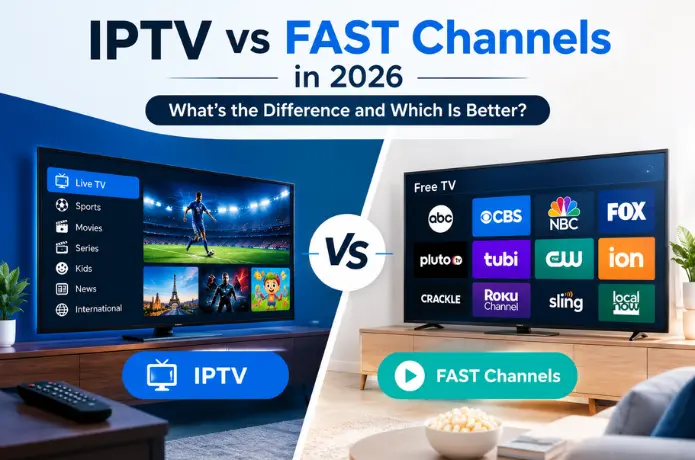

IPTV vs FAST Channels: What's the Difference and Which Should You Choose in 2026?
The way Americans watch TV has changed considerably in the last few years, and 2026 has more options than ever. Two terms you'll come across a lot right now are IPTV and FAST channels — and while both involve streaming TV over the internet, they work in quite different ways.
If you're trying to figure out which one makes sense for your household, or you're not entirely sure what either term actually means, this guide breaks it down clearly. We'll compare both options on cost, content, advertising, sports coverage, device compatibility, and overall viewing experience so you can make an informed decision.
What Is IPTV?
IPTV stands for Internet Protocol Television. It simply means television content delivered over the internet rather than through a traditional cable or satellite connection. Instead of a cable box connected to your wall, your channels come through your broadband connection.
An IPTV subscription typically gives you access to a lineup of live TV channels — news, sports, entertainment, international programming — often alongside on-demand content and a program guide. You access everything through an IPTV player app on whatever device you're using.
IPTV is compatible with a wide range of devices — Smart TVs, Firestick and Fire TV, Android TV boxes, phones, tablets, and laptops. The specific devices supported depend on the provider, so it's always worth checking before subscribing.
People choose IPTV because it tends to offer a broader channel selection than traditional broadcasting, at a lower cost than cable, and without long-term contracts. It's become a serious alternative to cable TV for many households across the USA.
What Are FAST Channels?
FAST stands for Free Ad-Supported Streaming Television. The name tells you a lot: the service is free to use, and it's funded by advertising rather than subscription fees.
FAST channels are designed to feel like traditional TV. Instead of picking from a library of on-demand content, you tune into a channel that's already running — a linear format where the schedule is set by the provider rather than the viewer. Think of it like the early days of cable TV, but delivered over the internet at no cost.
The ad model means you'll watch commercials in exchange for free access, in much the same way broadcast TV has always worked. Services like Pluto TV, Tubi, The Roku Channel, Samsung TV Plus, Amazon Freevee, and Peacock (in part) all operate FAST channels in the USA.
Content tends to lean toward general entertainment — older movies, classic TV series, news, lifestyle programming, and niche interest channels. It's a solid option for casual viewers who want something on in the background without paying a monthly fee.
IPTV vs FAST Channels: What's the Difference?
At a surface level, both deliver TV over the internet. But they're built on very different models and serve somewhat different needs.
| Feature | IPTV | FAST Channels |
|---|---|---|
| Cost | Varies by provider and plan | Usually free |
| Advertising | Depends on the service | Ad-supported |
| Live channels | Depends on provider | Yes — linear format |
| On-demand content | Depends on service | Often available |
| Channel selection | Can be very broad | Usually curated |
| Sports | Depends on provider | Limited and varies |
| International channels | Often available | Rarely |
| Internet required | Yes | Yes |
| Device support | Varies by provider | Varies by platform |
IPTV vs FAST: Cost Comparison
FAST channels are free. Full stop. You open the app, choose a channel, and watch. No signup required in most cases, no monthly fee, no credit card.
IPTV subscriptions are paid services. Pricing varies significantly between providers — you might pay anywhere from $15 to $80 per month depending on the channel lineup, plan length, and provider quality. The cost reflects access to a maintained server infrastructure, a curated channel list, and — with reputable providers — real customer support.
It's tempting to frame this as "free is obviously better," but that comparison only holds if both options offer the same content. They generally don't. FAST channels provide access to a curated selection of programming funded by advertisers. IPTV subscriptions, when well chosen, give you a broader live channel lineup without advertising interruptions — and often without the content restrictions that come with ad-supported models.
The right question isn't which costs less. It's which gives you what you actually want to watch.
IPTV vs FAST: Channel and Content Selection
This is where the two options diverge most significantly.
General entertainment is well served by both. FAST channels carry plenty of older movies, classic series, reality TV, and lifestyle content. A good IPTV subscription gives you live versions of those same genres alongside newer content.
News is available through both too, though the experience differs. FAST platforms carry some news channels in a linear format. IPTV services typically carry a wider range of national, regional, and international news channels simultaneously.
Movies and series lean in favour of FAST for on-demand depth — particularly for older or catalogue titles. IPTV is stronger for current movies broadcast live on premium channels.
International programming is an area where IPTV has a clear advantage. Most FAST platforms are heavily USA-focused. IPTV services often carry channels in multiple languages from multiple countries — important for viewers who want to follow content from elsewhere.
Live versus on-demand is a fundamental difference in how you consume content. FAST channels are scheduled — the program is running when you tune in, not waiting for you. IPTV gives you live access to channels as they broadcast, which is closer to what cable TV provided.
Which Is Better for Live Sports?
Sports rights are complicated, and this is worth being clear about.
FAST channels carry some sports programming, but it's usually limited — highlights shows, lower-tier leagues, college sports, or archived content rather than live premium events. Major live sports — NFL, NBA, MLB, NHL — are tied to licensing agreements that free ad-supported platforms rarely hold.
IPTV services vary on this too. Some providers carry a strong live sports lineup; others don't. Before subscribing to any IPTV service specifically for sports, check the channel list carefully for the leagues and networks you follow. Broad claims about "full sports coverage" should always be verified against the actual channel lineup.
For viewers where live sports is the primary reason for subscribing, doing that verification step before committing to any service — IPTV or otherwise — is worth the extra five minutes.
Which Is Better for Smart TVs and Firestick?
Both IPTV and FAST channels work across most popular streaming devices, though the path to getting them set up differs.
Smart TVs — Samsung, LG, and Sony models all have FAST platform apps built in or available through the TV's app store. Pluto TV and Samsung TV Plus, for example, are often pre-installed. IPTV requires installing a compatible player app and entering your provider credentials.
Firestick and Fire TV — Amazon Freevee is built into the Fire TV ecosystem, and Pluto TV, Tubi, and other FAST services are available from the Amazon App Store. IPTV players like IPTV Smarters Pro and TiviMate are also available from the App Store, making both options easy to access from the same device.
Android devices — both FAST apps and IPTV players are well supported on Android phones, tablets, and Android TV boxes through the Google Play Store.
In practice, most people who use Firestick or a Smart TV already have access to FAST channels through apps that came with the device. Adding an IPTV service on the same device gives you both options in one place.
Can You Use IPTV and FAST Channels Together?
Yes — and for many households, this is actually the most practical approach.
FAST channels handle casual viewing well. If you want something on in the background while you cook, a free ad-supported channel does that job without costing anything. For scheduled live TV, sports, news, or international programming, an IPTV subscription covers the gaps that FAST platforms leave.
The two aren't in direct competition. They serve different viewing modes. Using both — free FAST channels for casual consumption, IPTV for the live content that matters to you — gives you flexibility without paying for more than you need.
Most people who make this combination work find that they reach for IPTV during the evening for planned viewing, and FAST for background television during the day. Your own pattern will vary, but the point is that you don't have to choose one or the other.
IPTV vs FAST Channels: Which Should You Choose in 2026?
There's no single right answer. It depends on what you watch, how often, and what you're willing to pay.
FAST channels make sense if:
- You want free access to general entertainment without a monthly commitment
- You don't mind watching advertisements
- Your viewing habits lean toward casual, background television
- You mainly want movies, classic series, or lifestyle content
IPTV makes sense if:
- You want a live channel lineup that more closely replaces what cable provided
- You want control over which specific channels are in your package
- You follow international content or need channels in other languages
- You want live sports or news with a broader selection of channels
- You'd rather pay a set monthly amount and watch without ads
For most households, the answer isn't either/or. Starting with the FAST channels already available on your device — which cost nothing — and adding an IPTV subscription for the specific content that matters to you is a reasonable way to approach it.
Frequently Asked Questions
What does FAST mean in streaming? +
Are FAST channels really free? +
Is IPTV the same as FAST TV? +
Do FAST channels show live TV? +
Can I watch FAST channels on Firestick? +
Which is better — IPTV or FAST channels? +
Looking for a Flexible IPTV Option?
If you're ready to try IPTV alongside the FAST channels you already have access to, FireLive TV is worth a look. It offers 6,000+ live HD channels across sports, news, entertainment, and international programming — available on Smart TVs, Firestick, Android boxes, phones, and tablets.
Plans start at $29.99 per month with no long-term contract, and there's a free 24-hour trial with full channel access and no credit card required. If you're comparing your options, testing an IPTV service on your actual device is the most useful way to decide whether it adds value on top of what FAST channels already give you for free.
Still have questions? Chat with us now for a free trial. We're online 24/7.