
Why Sports Streaming Is Becoming More Fragmented in 2026
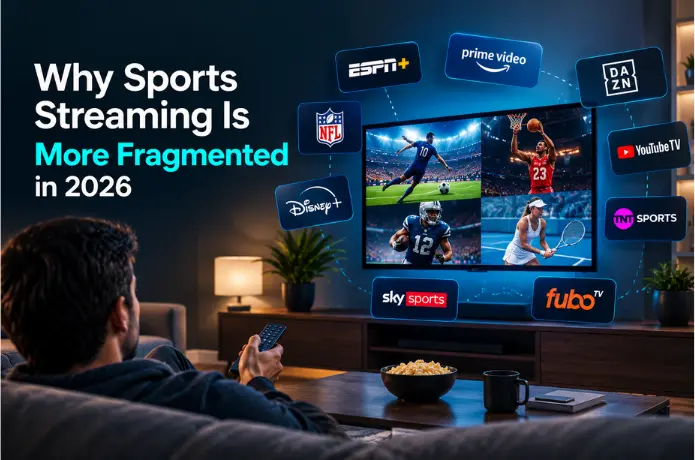
Ask a sports fan in 2026 which app they need to watch tonight's game, and the honest answer is often "it depends which game." Sports streaming fragmentation has moved from an occasional annoyance to the defining feature of how live sports get distributed, and this year has made the pattern more obvious than ever — a single league's season can now be split across six or seven completely different platforms.
This isn't an accident or a temporary phase. It's the result of deliberate strategy by leagues, and understanding why it's happening helps explain why the situation isn't likely to simplify anytime soon.
The Scale of the Problem in 2026
The numbers this year illustrate just how far the splitting has gone. MLB's national broadcast rights alone are now divided across NBC, Peacock, Netflix, ESPN, Fox, TBS, and Apple TV+ under its 2026–2028 deals — meaning a baseball fan trying to follow the sport nationally could need up to six separate subscriptions depending on which games they want to catch. The NFL, meanwhile, spreads its games across Prime Video, Peacock, ESPN/ABC, Paramount+, Netflix's Christmas Day games, and YouTube's Sunday Ticket package.
The NBA isn't far behind, having signed a rights arrangement spanning Disney's ESPN/ABC, Amazon Prime Video, and NBCUniversal. Even Roku, long known primarily as a streaming device maker rather than a broadcaster, has picked up a slice of MLB games this year — a sign of just how far the bidding has spread beyond traditional players.
Why Leagues Are Choosing to Split Their Rights
It would be easy to assume this fragmentation is happening by accident, but leagues are doing this deliberately, and the financial logic behind it is straightforward.
Splitting rights maximizes revenue
Selling one exclusive package to a single broadcaster puts a ceiling on what a league can earn. Slicing rights into smaller packages — by day of week, by platform, by region — lets a league run multiple competitive bidding processes instead of one, and each package can go to whichever buyer values that specific slice the most.
Streaming giants are willing to overpay for exclusivity
Companies like Netflix, Amazon, and Apple have shown they're willing to pay enormous premiums for live sports specifically because live events are one of the few things that still reliably pull in large, appointment-viewing audiences in an on-demand world. That willingness to overpay for exclusive access directly encourages leagues to keep carving out new exclusive packages to sell.
Regional sports networks are collapsing
The traditional Regional Sports Network model, which once bundled local team coverage into cable packages, has been under serious financial pressure, with some RSNs facing liquidation. As that system breaks down, teams and leagues have been forced to build new direct-to-consumer and streaming arrangements team by team rather than relying on one regional broadcaster, which adds yet another layer of fragmentation on top of the national rights picture.
Fragmentation by the Numbers
| League | Platforms Involved in 2026 |
|---|---|
| NFL | Prime Video, Peacock/NBC, ESPN/ABC, Paramount+/CBS, Netflix, YouTube |
| MLB | NBC, Peacock, Netflix, ESPN, Fox, TBS, Apple TV+ |
| NBA | Disney (ESPN/ABC), Amazon Prime Video, NBCUniversal |
| Premier League (UK) | Sky Sports, TNT Sports, Amazon Prime Video |
Industry research backs up how this feels on the ground for viewers. Reporting from Hub Entertainment Research this year found that fragmented rights deals are forcing fans to juggle multiple apps and subscriptions just to follow a single team, with many describing the process of simply locating a game as one of their biggest frustrations with modern sports viewing.
Is Anything Pushing Back Against Fragmentation?
There are early signs of both regulatory and market pushback. The FCC opened a formal inquiry in early 2026 into how streaming has affected broadcasters' ability to secure sports rights and whether public access to live sports is being adequately protected. Separately, state broadcast associations have called for Congressional review of the decades-old Sports Broadcasting Act, which originally granted leagues the antitrust exemption that allows this kind of collective rights negotiation in the first place.
On the market side, some smaller platforms are explicitly positioning themselves as the antidote to fragmentation rather than contributing to it — bundling multiple leagues' local rights into simpler, sometimes free, ad-supported packages aimed at fans who just want an easier way to find their team.
What This Means for How Fans Actually Watch
The practical result is that "just turn on the game" has become a genuinely more complicated task than it used to be. Following a single team across a full season can require checking multiple apps depending on the day, the opponent, and even the time slot. This is a big part of why IPTV has grown in popularity — a well-built channel lineup that consolidates sports networks, regional coverage, and international feeds into one place removes a lot of the app-switching that fragmented rights deals have created.
It's not a perfect substitute for every exclusive streaming deal, since some platform-exclusive games genuinely can't be found anywhere else. But for the broader landscape of sports programming — the networks, the highlight shows, the regional coverage — having it consolidated in one lineup meaningfully cuts down on the subscription juggling that's become the norm in 2026.
The Bottom Line
Sports streaming fragmentation in 2026 isn't a temporary growing pain — it's the direct result of leagues maximizing rights revenue by selling smaller, more numerous packages to an increasingly competitive field of streaming giants. Regulatory scrutiny is picking up, but nothing has meaningfully slowed the trend yet. For most fans, the practical response has been finding ways to consolidate access rather than waiting for the industry to simplify on its own.
If keeping track of scattered sports coverage across too many apps has become exhausting, FireLive TV brings 6,000+ live channels — including sports, news, and international programming — into a single lineup across Firestick, Smart TVs, Android boxes, phones, and tablets. You can start a free 24-hour trial with no credit card required to see the current channel list for yourself.
Still have questions? Chat with us now for a free trial. We're online 24/7.