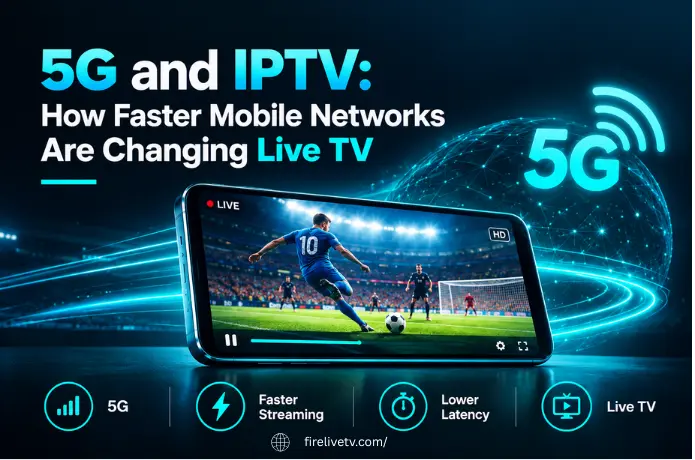

5G and IPTV: How Faster Mobile Networks Are Changing Live TV
A few years ago, watching live TV on your phone while out of the house meant accepting a compromise — a lower resolution stream, occasional buffering, and the constant risk of your connection dropping out the moment you left Wi-Fi range. 5G and IPTV together are starting to close that gap, and for a lot of viewers, mobile streaming now looks and feels a lot closer to watching on a home network.
This isn't just marketing language from network providers. There's a real technical reason 5G matters specifically for live television, as opposed to on-demand content, and it's worth understanding what's actually changed versus what's still limited by other factors.
Why Live TV Is a Different Challenge Than On-Demand Video
On-demand streaming has an advantage that live TV doesn't: it can buffer ahead. While you're watching one scene of a downloaded or cached video, the next few minutes are quietly loading in the background. If your connection dips for a moment, you often don't even notice.
Live TV doesn't get that cushion. A live match or news broadcast is being delivered to your device in real time, which means any weakness in your connection shows up immediately as freezing, pixelation, or a channel that takes too long to load. This is exactly why mobile network quality has historically mattered more for IPTV than for services like on-demand movie streaming — and why an upgrade like 5G has a more noticeable effect on live viewing specifically.
What 5G Actually Changes for Mobile IPTV
Higher sustained speeds
4G networks could technically handle HD streaming, but performance dropped noticeably in crowded areas or during peak usage hours. 5G networks are built to sustain much higher throughput even when a lot of devices are connected to the same tower, which matters enormously for something like a stadium full of people trying to stream a match at the same time.
Lower latency
Latency — the delay between a signal being sent and received — has a direct effect on how quickly a live stream can start, how fast you can switch channels, and how well the stream recovers from a brief network hiccup. 5G's lower latency compared to 4G means less waiting and fewer awkward pauses when you're navigating a live channel guide on your phone.
Better handling of network congestion
One of the most practical improvements is how 5G networks manage many simultaneous connections. Large public events — sports venues, concerts, transit hubs — used to be some of the worst places to stream live TV on mobile data because everyone nearby was competing for the same limited bandwidth. 5G's architecture is specifically designed to reduce that kind of congestion, which is a direct benefit for anyone trying to catch a live game from their phone in a crowded setting.
More consistent 4K mobile streaming
4K streaming on mobile was previously reserved mostly for strong Wi-Fi connections. With sufficient 5G coverage, sustained 4K live streaming on a phone or tablet becomes realistic without constantly dropping down in quality to compensate for network limitations.
4G vs 5G for Live IPTV: A Practical Comparison
| Factor | 4G | 5G |
|---|---|---|
| Typical speed | 10–50 Mbps | 100 Mbps – 1 Gbps+ |
| Latency | 30–50ms | 1–10ms |
| Performance in crowds | Degrades significantly | Holds up much better |
| 4K live streaming | Inconsistent | Generally reliable with coverage |
| Channel switching speed | Noticeable delay | Near-instant |
These figures represent typical real-world ranges rather than theoretical maximums, since actual performance always depends on carrier, location, and device.
What 5G Doesn't Fix
It's worth being upfront about the limits here, because 5G isn't a universal solution to every IPTV problem.
Coverage is still inconsistent. 5G rollout varies enormously by region and carrier. Rural and less densely populated areas often still rely primarily on 4G, and even in covered cities, indoor 5G matters signal can be weaker than outdoors depending on building materials.
Data caps still apply. A faster connection doesn't mean unlimited data. Streaming live TV, especially in 4K, consumes data quickly, and mobile plans with capped data can hit their limits faster on 5G simply because the stream quality is higher by default.
Device compatibility matters. Not every phone or tablet supports the full range of 5G bands available from every carrier, which can lead to inconsistent real-world speeds even in areas with strong 5G coverage.
Server-side performance is still a factor. A fast network connection only helps if the IPTV provider's own servers can keep up with demand. A strong 5G signal paired with an overloaded or poorly maintained streaming server will still produce buffering.
What This Means for How People Watch Live TV
The practical effect of better mobile networks is that live TV is becoming genuinely location-independent in a way it wasn't a few years ago. Watching a live match on a train, catching the news while waiting somewhere, or keeping a channel running during a commute is increasingly viable without the constant quality drop-offs that used to make mobile IPTV frustrating.
This also changes expectations. As 5G coverage expands, viewers increasingly expect mobile streaming to match home streaming quality, which puts more pressure on IPTV providers to maintain strong server infrastructure that can actually deliver on what the network now makes possible.
The Bottom Line
5G hasn't eliminated every challenge with mobile live TV, but it has meaningfully closed the gap between watching at home and watching on the go. Higher speeds, lower latency, and better handling of crowded networks all directly benefit live streaming in ways they don't benefit pre-buffered, on-demand content nearly as much. Coverage gaps, data caps, and server-side performance still matter — but where 5G is available and paired with a reliable IPTV provider, mobile live TV now holds up far better than it used to.
If you want to see how live streaming performs on your own device and network, FireLive TV offers 6,000+ live HD channels across sports, news, entertainment, and international programming, accessible on phones and tablets as well as Firestick, Smart TVs, and Android boxes. You can start a free 24-hour trial with no credit card required to test it on whatever network you're using.
Still have questions? Chat with us now for a free trial. We're online 24/7.